
Best Couples Card Games for Communication (Ranked)


The best couples card games don't just break the ice - they restructure how two people talk to each other, creating the kind of conversation that daily life rarely makes space for.
A couples card game is a structured prompt system that uses external questions or challenges to lower the emotional cost of vulnerable conversation between partners.
Most couples don't struggle because they don't care. They struggle because they don't have a reliable way to start the conversations that matter. Card games, at their best, solve exactly that problem.
TL;DR
- Couples card games work because they externalize the "ask" - neither partner has to initiate vulnerability alone.
- The best games are psychologically layered, not just entertaining.
- Physical card decks have a meaningful ritual advantage over scrolling a list on a phone.
- Not all games suit all relationship stages - a deck for new couples will frustrate a long-term pair, and vice versa.
- Research on couples communication confirms that structured conversation tools measurably increase emotional intimacy.
- Games focused on desire and play serve a different need than games focused on emotional depth - you need both.
- Digital alternatives like Flamme extend the ritual into daily life where physical card decks cannot.
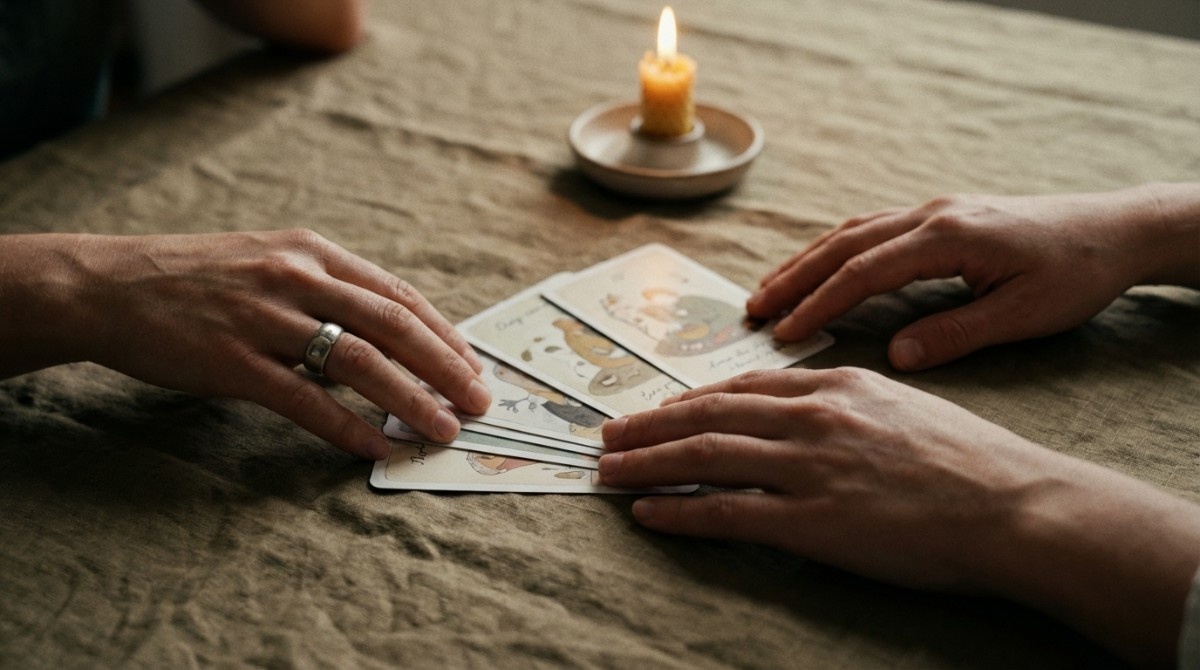
What Is a Couples Card Game?
A couples card game is any structured prompt deck designed to generate conversation, reveal preferences, or facilitate emotional bonding between two people in a romantic relationship.
The format varies - some use question cards, some use challenges, some alternate between revelations and dares. But the underlying mechanism is the same: the card asks what the person didn't.
This matters more than it sounds. Research on self-disclosure in relationships shows that reciprocal vulnerability - the process of both people revealing something meaningful in turns - is one of the strongest predictors of emotional closeness. The card game structure engineers this process without requiring either partner to feel exposed or performative. The game takes the social risk so you don't have to.
Statistics & Research Insight
- Psychologist Arthur Aron's landmark study on interpersonal closeness found that structured, escalating self-disclosure between strangers produced feelings of closeness comparable to long-term friendship - in under 45 minutes. Couples card games apply the same mechanism to existing relationships.
- A 2020 study in the Journal of Social and Personal Relationships found that couples who engaged in novel, structured activities together reported significantly higher relationship satisfaction after six weeks compared to couples who maintained routine interactions.
- According to Gottman Institute research, the ratio of positive-to-negative interactions during couples communication is a stronger predictor of relationship stability than the frequency of conflict itself.
What this means for card games: novelty, structure, and positive emotional tone are the three ingredients that predict intimacy gains. The best card games deliver all three at once.
Key Insight: The ritual of physically drawing a card, sitting together, and answering without a screen in front of you creates a psychological container for presence. That container - not the questions alone - is what generates intimacy.
Why Do Couples Card Games Improve Communication?
The Problem They Solve
Most long-term couples fall into what communication researchers call topical narrowing - over time, conversation contracts around logistics, routines, and familiar territory. You stop asking questions you assume you know the answer to. You stop exploring each other.
This isn't apathy. It's an attentional shortcut. The brain conserves energy by treating familiar people as known quantities. Card games interrupt that shortcut by introducing questions neither partner would generate on their own.
Why the Physical Format Matters
There's a meaningful difference between pulling a card from a deck and scrolling through a list on your phone. The physical act creates an event. It signals that this moment is different from the other moments in your day. Couples communication researchers refer to this as ritual marking - the use of a distinct object or behavior to transition into a different relational mode.
This is also why card games outperform most relationship apps for in-person use: the phone is associated with distraction, notifications, and individual activity. A card deck has one meaning, shared.

How to Choose the Right Couples Card Game
The Four Types of Couples Card Games
Not all decks are built for the same purpose. Understanding what each type is designed to do helps you choose the right tool for where you and your partner actually are.
Type
What It Does
Best For
Emotional Depth
Icebreaker / Discovery
Surfaces preferences, histories, and light curiosity
New couples, first few months
Low-medium
Emotional Intimacy
Escalating vulnerability, values, and fears
Long-term couples, reconnection
High
Desire & Play
Sexual preferences, fantasies, playful dares
Any stage, reigniting physical intimacy
Medium-high
Conflict Navigation
Structured disagreement tools, repair frameworks
Couples working through friction
Reflective
Most couples benefit from rotating across all four types across different evenings rather than committing to a single deck.
Quick Framework: How to Run a Card Game Session That Actually Works
- Choose your mode before you start. Decide whether tonight is light and playful, emotionally exploratory, or physically intimate. Different modes require different decks and different psychological readiness.
- Put phones face-down. Not across the room - face-down on the table is the minimum viable commitment to presence.
- Use a pass rule. One or two passes per person, no justification needed. This preserves safety without making the game toothless.
- Don't rush answers. The pause before answering is where honesty forms. Resist the impulse to fill silence immediately.
- Follow up, don't just proceed. The card is the prompt. The real conversation is what happens after the first answer.
The Best Couples Card Games, Ranked and Reviewed
These are assessed on four criteria: psychological depth, conversation quality, reusability, and stage appropriateness.
1. We're Not Really Strangers (Couples Edition)
Best for: Emotional intimacy, long-term reconnection
WNRS built its reputation on questions that feel too personal for polite conversation and just vulnerable enough to be honest. The couples edition adds a layer of relationship-specific revelation - questions about what you've assumed about each other, what you've been afraid to say, what you'd do differently.
The three-level structure (Perception, Connection, Reflection) mirrors the escalating self-disclosure pattern from Aron's closeness research. It starts safe and builds deliberately.
Limitation: It can feel emotionally heavy if the relationship is already under stress. Best used when both partners are genuinely curious, not when one is reluctant.
Conversation quality: Very high Reusability: Medium (questions don't change, but answers do over time) Stage: Long-term couples, reconnection moments
2. TableTopics Couples
Best for: Regular use, light intimacy, varied conversation
TableTopics is less emotionally demanding than WNRS, which makes it more sustainable as a recurring ritual rather than a special-occasion game. The questions range from nostalgic to playful to mildly revealing - no single card will break you open, but 20 minutes with this deck will leave you knowing something new about your partner.
Limitation: The ceiling is lower. If you're looking for genuine emotional depth, this deck won't take you there alone.
Conversation quality: Medium-high Reusability: High (large card count, broad variety)
Stage: All stages, ongoing ritual use
3. Intimacy Deck (by BestSelf Co.)
Best for: Sexual communication, desire, physical intimacy
The Intimacy Deck bridges emotional and physical intimacy in a way most card games avoid. Questions address desire, turn-ons, fantasies, and sexual preferences in a tone that's direct without being clinical. For couples who want to improve couples communication around sexuality - which research consistently identifies as the single strongest predictor of sexual satisfaction - this deck provides structure that neither partner has to engineer alone.
Limitation: Requires existing psychological safety. This is not a first-date deck, and it's not useful when there's unresolved emotional tension.
Conversation quality: High (within its domain) Reusability: Medium Stage: Established couples, sexual reconnection
4. The Gottman Card Decks (App-Based)
Best for: Emotionally intelligent, research-backed conversations
The Gottman Institute's card decks - available as a free app - are built directly from decades of couples research. They cover love maps (knowing your partner's inner world), bids for connection, dreams and aspirations, and conflict management. They're less playful and more therapeutic, which makes them genuinely powerful for couples who want evidence-based relationship tools.
Limitation: The app format loses the ritual advantage of a physical deck. Best used intentionally, not casually.
Conversation quality: Very high Reusability: Very high (multiple deck categories, ongoing use) Stage: All stages, especially couples in active growth
5. Deckible / Conversation Starter World
Best for: Large variety, low commitment to emotional depth
These decks prioritize breadth - hundreds of questions across light, medium, and occasionally deep territory. They work well for couples who want conversation variety without the emotional weight of more intensive decks.
Limitation: Inconsistent question quality. Some cards feel shallow or generic.
Conversation quality: Medium Reusability: Very high Stage: New couples, casual ongoing use

When NOT to Use a Couples Card Game
Card games are valuable precisely because they create structured vulnerability. That same structure can backfire in the wrong context.
Avoid using couples card games when:
- One partner is clearly reluctant or playing to please rather than to participate. Performative engagement produces surface answers, not connection.
- There's an unresolved conflict in the room. The game can surface raw material without the psychological space to process it properly.
- You're using the game to avoid a direct conversation you've been postponing. That conversation needs to happen on its own terms.
- You're both emotionally depleted. Vulnerability requires presence and bandwidth. A tired, distracted session is worse than no session.
The best card game sessions happen when both partners are genuinely curious and there's enough safety to say "I'd rather skip that one."
What Happens If You Make This a Regular Ritual?
The research on relationship rituals is consistent: couples who maintain intentional shared practices - small, recurring moments of connection - report higher relationship satisfaction, lower conflict intensity, and stronger emotional intimacy over time.
A single card game evening is useful. A weekly ritual compounds.
The reason most couples abandon card games after one or two sessions isn't that the games aren't good - it's that the setup friction is too high. You have to find the deck, agree to play, create the atmosphere. Over time, that friction wins.
This is where a daily digital prompt system serves a different purpose than a physical deck. Not as a replacement - the ritual value of a physical card is real - but as a way to extend the practice into ordinary days when the deck isn't on the table.
💡 Want to turn conversation into a daily habit instead of an occasional event? Flamme delivers guided relationship questions every day - no setup required. Try Flamme →
Final Takeaway
The best couples card game isn't the one with the best questions - it's the one you actually use consistently. Start with a deck matched to your relationship stage. Build the ritual before you try to escalate the depth. Follow up on answers. Notice what the silence before an answer is telling you.
Physical card games give you an evening. Daily relationship practices give you a relationship.
Beyond Game Night: Building a Daily Conversation Practice
A well-chosen card game can open a conversation your relationship needed. What it can't do is show up on a Tuesday morning when you're both rushing out the door but one of you is carrying something heavy.
The limitation of any physical card deck is structural: it requires occasion. You need to decide to play, set the mood, and carve out the time. For occasional depth, that works. For the kind of consistent emotional intimacy that actually changes a relationship's baseline, you need something that fits inside daily life.
Flamme was built for exactly that gap. It's a guided daily relationship ritual app that delivers conversation prompts, emotional check-ins, and bonding exercises - calibrated to your relationship stage and communication style - every single day.
What Flamme gives couples that a card deck can't:
- Daily prompts delivered automatically, removing the setup friction that kills most relationship rituals
- Long-distance bonding tools that maintain emotional intimacy across time zones and schedules
- An AI relationship coach that helps you navigate miscommunication and emotional disconnects in real time
Before you start, it helps to understand your own connection style. Flamme's Type of Lovers quiz identifies how you and your partner experience and express intimacy - so the questions you're working through together are actually relevant to how you both connect, not just generically "deep."
The goal isn't a better game night. It's a relationship that doesn't need rescuing.
Download Flamme and grow closer every day →
FAQ
Q1: What is the best card game for couples to improve communication?
The best couples card game for communication depends on your relationship stage. We're Not Really Strangers (Couples Edition) is best for emotional depth and long-term reconnection. TableTopics Couples is better for regular, lower-pressure conversation practice. The Gottman Card Decks offer the most research-backed structure for couples actively working on their relationship.
Q2: Do couples card games actually help relationships?
Yes, with caveats. Couples card games work because they create structured self-disclosure - both partners reveal something in turns, which research consistently links to increased emotional closeness. The benefit comes from consistent use, not a single session. One good game night is useful; a weekly ritual is what changes a relationship's baseline communication quality.
Q3: What's the difference between couples card games and relationship apps?
Physical card games create a ritual advantage - the act of drawing a card signals presence and shared attention in a way a phone screen rarely does. Relationship apps like Flamme extend the practice into daily life, removing the setup friction that causes most couples to abandon card game habits. Both serve different functions; the strongest approach uses both.
Q4: How often should couples use conversation card games?
Research on relationship rituals suggests that frequency matters more than intensity. A 15-minute weekly card game session produces more cumulative benefit than a single two-hour deep-dive once a month. The goal is to make structured conversation a habit, not an event.
Q5: Are couples card games useful for long-distance relationships?
Yes, with format adaptation. Many couples play via video call, sharing a deck or using digital versions. The Gottman Card Decks app works well for this. For daily long-distance connection, an app like Flamme provides consistent emotional intimacy prompts across distance without requiring scheduled game sessions.